


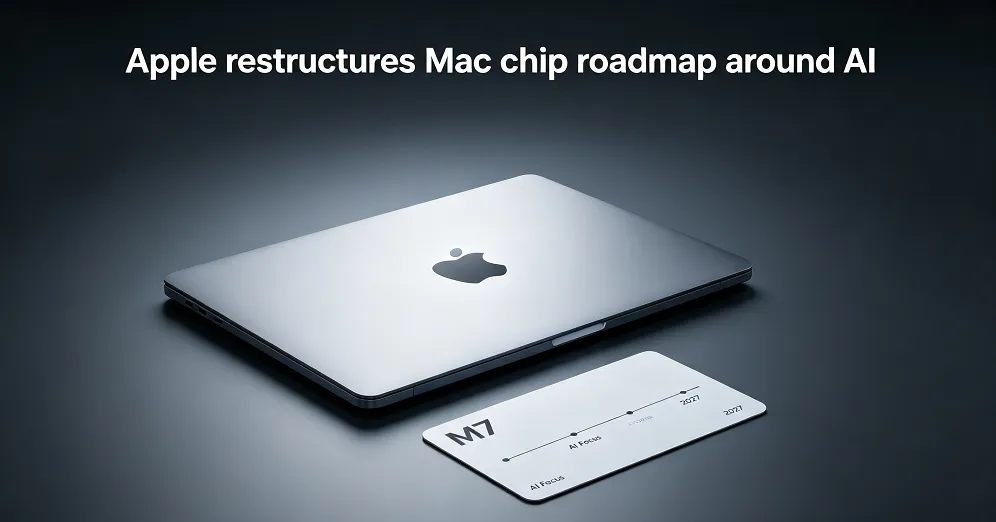
Katika hatua ambayo haijawahi kutokea, Apple imerekebisha kwa kasi ramani yake ya barabara ya Mac chip, kuacha mipango ya M6 Pro ya hali ya juu, Kiwango cha juu cha M6, and M6 Ultra processors to focus engineering resources on the next-generation M7 family. The decision marks the first time since Apple Silicon debuted in 2020 that the company has skipped an entire tier of performance chips in a single generation.
What Remains of the M6 Lineup
The standard M6 chip is still on track for a late 2026 kutolewa. It will appear in entry-level MacBook Pro models, Mac mini, iMac, and select iPad Pro and iPad Air configurations. But that is where the M6 story ends. No Pro, no Max, no Ultra—something that has become a predictable rhythm for Apple’s chip releases is now broken.
AI as the Driving Force
The abrupt shift comes down to one word: AI. According to Bloomberg’s Mark Gurman, Apple had planned substantial neural-processing upgrades for the M7 family and ultimately decided those improvements were important enough to justify accelerating the next generation rather than completing the M6 product line.
As Gurman put it in his Power On newsletter, “AI is no longer just a feature that Apple chips need to support—it is now determining how these products are designed and when they are released.”
The New M7 Roadmap
The accelerated timeline for M7 is equally striking. Apple began taping out the M7 just six months after finalizing the M6 design, compressing what is normally a 12-to-18-month gap into half that time. The new schedule looks like this: base M7 in the first half of 2027, M7 Pro and M7 Max in the second half of 2027, and the flagship M7 Ultra arriving in 2028.
Performance targets for the M7 base chip include memory bandwidth of 240 GB/s—roughly 57 percent higher than the M5 Max’s 153 GB/s. The M7 Ultra is even more ambitious, designed to support up to 1.5 terabytes of unified memory, double the planned capacity of the M5 Ultra. Apple is reportedly aiming for AI performance that approaches dedicated accelerators like Nvidia’s Blackwell GPUs.

Implications for Professional Users
The decision creates a significant upgrade gap for high-end Mac users. The redesigned OLED MacBook Pro, originally expected in late 2026, has been pushed to early 2027—and will still ship with M5 Pro and M5 Max processors, offering no performance advantage over current machines.
Users who need the highest performance will have to wait until late 2027 au 2028 for a true next-generation chip. Apple is attempting to bridge this gap by releasing an M5 Ultra-powered Mac Studio later this year, offering some upgrade path for professionals.
AI Ambitions Beyond the Mac
The M7 Ultra is not just for Macs. Gurman reports that Apple is evaluating the chip as the backbone for Apple Intelligence servers starting in 2029. This signals a broader ambition: Apple is designing its Mac silicon to rival dedicated AI infrastructure hardware from Nvidia, a shift that moves the company into an entirely different competitive space.
The decision to skip the M6 high-end chips was reportedly influenced by additional factors: a global memory shortage that has driven DDR5 prices up by over 300 percent year-over-year, and tightening capacity at TSMC’s 2nm fabs, which are heavily booked by AI companies. Both pressures made it more practical to conserve resources for the AI-focused M7.

Egemeo la Kimkakati
This is not a minor adjustment. Apple is breaking its own product cadence to chase the AI wave with urgency. The company that once revolutionized mobile computing is now reshaping its silicon strategy around a single priority: making AI run faster, and run locally, on its own hardware.